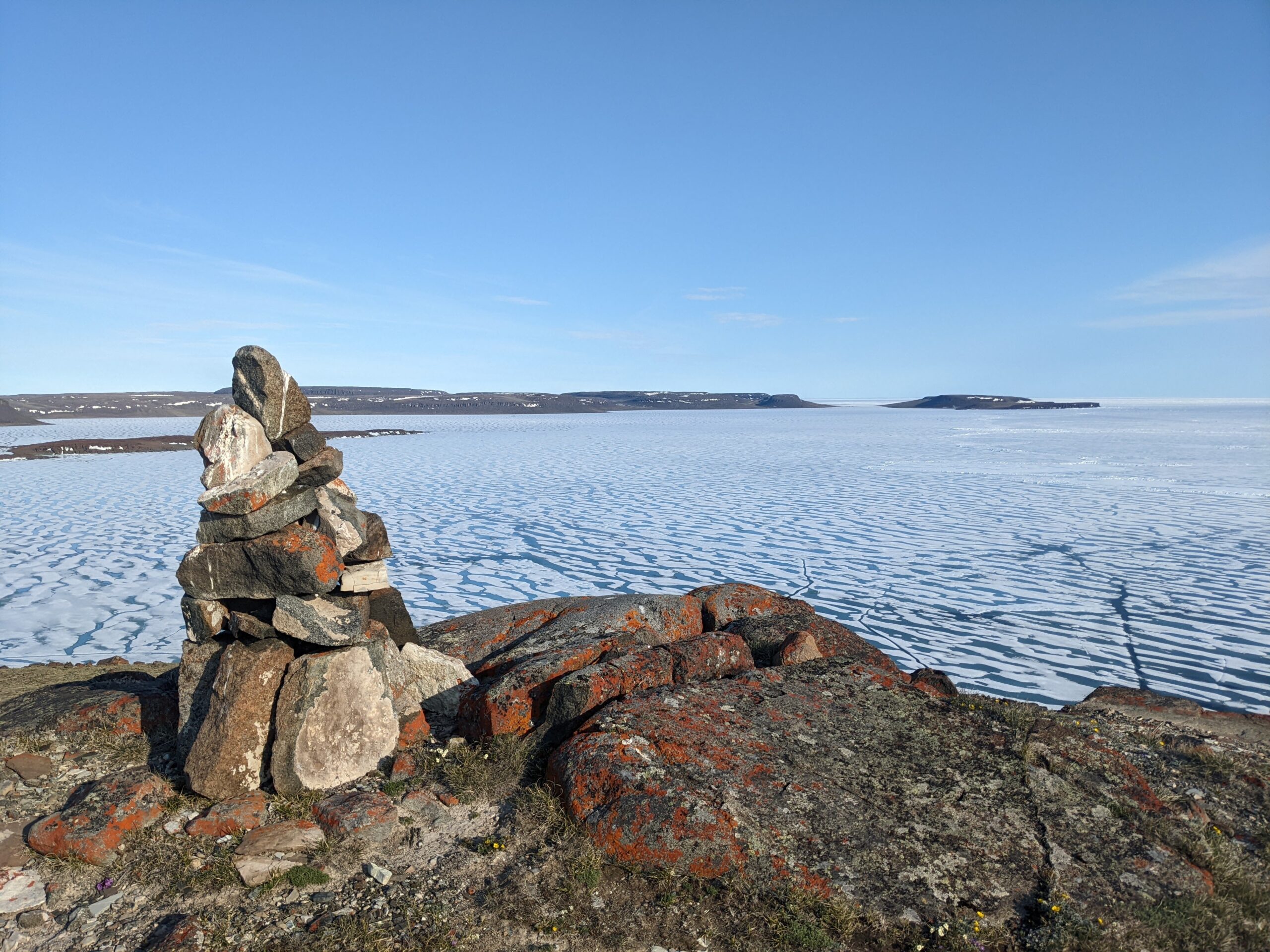
In 2022 and 2023, I spent approximately a month helping build and deploy a small-scale community owned cellular network in the remote Island town of Ulukhaktok, in Canada’s Northwest Territories. This particular network was many, many years in the making, and an incredibly successful and rewarding project. The work actually got a surprising amount of press, some links included below.
https://www.rcinet.ca/eye-on-the-arctic/2023/09/06/could-ulukhaktoks-community-network-be-an-internet-model-for-other-communities
https://www.internetsociety.org/blog/2023/10/building-more-affordable-and-reliable-internet-access-in-the-arctic/
https://irc.inuvialuit.com/news/internet-society-launches-worlds-first-community-network-in-the-arctic-circle/
https://jsis.washington.edu/canada/news/uw-researchers-travel-to-ulukhaktok-northwest-territories
Local Context
Ulukhaktok is very far North, at slightly over 70 degrees latitude. So far North it’s actually off the mainland, and is located on the Western shore of Victoria Island in the Arctic Ocean. As you might expect, this makes connectivity… pretty hard, and not so great.

When I got involved at the start of the project in 2019, all connectivity was powered by NorthwesTel, which connected the community to its central office in Whitehorse via a geostationary satellite, Anik-F2, which is currently in the process of slowly failing. Connectivity options available included (1) very high latency (~3 seconds RTT) cable phone service, (2) spotty, latent, and unreliable 2G cellular coverage, and (3) high-latency DSL Internet on the order of <5 Mbps. I was not able to obtain exact details on rates, but we heard many complaints about affordability, with some residents citing monthly bills of over 1,000 CAD. Additionally, it was not uncommon for community-wide outages to occur, sometimes lasting weeks at a time, due to backhaul related failures, either in the satellite link or the single fiber line that connects Whitehorse to the rest of the Internet.1


These outages, and the way the community handled them, were endlessly fascinating to me. In the modern hyper-connected age, an Internet outage disrupts literally everything, from ATMs and credit card terminals to even local phone calls (due to the central-routed architecture used by every telco today, including NorthwesTel). Nevertheless, the community just kept on keeping on. When no one is able to use credit cards or ATMs, the community simply shifts to a paper IOU system, to be settled once things come back online. Similarly, the local police station simply put up signs directing people to a specific house address if 911 was down and they needed help in off-hours.


The Plan
Our plan for connectivity was pretty straightforward, a mix of hyper-local infrastructure and backhaul improvements. On the local side, we planned to build a wholly self-contained LTE network operating at 850MHz (we got a license, don’t ask me how). This network would have relatively high bandwidth (total local downlink of several hundred Mbps), cover the entire community, and (most importantly) keep all local traffic within the community. This would have immediate and dramatic implications for network resilience (since local comms stay up during backhaul failures), Internet speed (since all local traffic would be kept off the backhaul link), and just general quality of service for things like phone calls (since local calls would no longer have to traverse a 500ms satellite link four times).
On the backhaul side, we iterated through several increasingly complicated plans, but couldn’t get away from the core challenges the North presented: incredibly long and remote distances across incredibly inhospitable terrain. After iterating through several increasingly wacky plans (long distance fiber, microwave relays, etc.) we settled on a partnership with a LEO satellite network provider who wanted to test their network in extreme contexts. Unfortunately, the provider then immediately entered bankruptcy and dashed the deal. This would have been a major roadblock for us, except before we had to make any formal decisions, COVID happened, closed the US-Canada border, and firmly halted the project for us.
COVID Delays and Starlink Launches
COVID closed everything down, and the project sat on ice (pun intended) for a couple of years, until we were finally able to return North in the Summer of 2022. Interestingly enough, this delay gave us just enough time for Starlink to launch their polar orbit, providing a convenient and affordable solution to our backhaul challenges. We bought a terminal and brought it North with us, with a pretty simple architecture/plan: build the cellular network, and just connect it to the Starlink terminal for backhaul connectivity.
In a development that was both surprising and totally-should-have-seen-it-coming… as soon as Starlink started providing coverage, many community members immediately jumped on it. By the time we finally made it up to Ulu, we noticed dozens of Starlink terminals mounted on all sorts of buildings – both community structures and private residences. At first this made me a little nervous that we had showed up too late, or really had nothing to offer the community, but this was far from true. More on this below.


Current Status
Building the network, and launching it with a community celebration, all went off without a hitch. The network tends to experience a few intermittent outages each year, almost always when the community loses power due to winter storms, but everything settles down nicely once the weather improves. I’ve actually come to appreciate these outages, since they usually lead to a flurry of emails from various community members. I usually tend to dislike it when my inbox gets hammered, but it’s nice to know people care about the network and are using it. Plus, over these years I’ve actually come to know some of the community members pretty well due to these same repeated email exchanges. Always fun to have a pen-pal somewhere interesting.
Due to some technical limitations that deserve their own article, the network has a few key drawbacks that restrict its usefulness to the community. First off, we don’t support iPhones, and have limited ability to change this until we’re able to get some help from someone internal at Apple. This has been a known issue for us for years, but was a non-factor in prior work, due to Android’s total market domination outside of North America. However, in Ulukhaktok, iPhones make up a substantial chunk of the community’s phone ownership. For similar technical reasons that I’ve explained earlier, the network also does not support voice and text, but just as in Bokondini, widespread community use of OTT apps like WhatsApp or Signal makes this much less of a factor.
Since the network launch, I’ve been in sporadic contact with various community members, and am pleasantly surprised by how popular and well-appreciated the network is. At any given time we’ll see anywhere from 100-200 users (max maybe 300?) which is pretty strong uptake for a community of approximately 500 people.
More Notes On Starlink
I expect to be seeing more of this type of network context in the future – specifically, contexts where the incumbent provides poor or nonexistent coverage and individual community members supplant it with Starlink/OneWeb/any other commercial LEO provider. As such, I thought it might be a good idea to jot down some of the main takeaways and tradeoffs I heard during our time in Ulukhaktok. If I had to summarize, I’d say that Starlink certainly is helping the context substantially, but several issues remain to be worked on – no “silver bullets” exist in this line of work, indeed.
Issue #1: Starlink is expensive! When asking community members about Starlink, the first thing we heard was “it works pretty well,” immediately followed by complaints about how expensive it is. Many people mentioned making the decision month-by-month, whether to keep service or suspend it for the coming month in order to save the fee.
This challenge of affordability is incredibly important, and often brought up in digital equity discussions, because there is literally no difference between “no Internet” and “no affordable Internet” when it comes to an end user’s experience. To this point, if you’re willing to pay good money you can already get Internet (or phone) coverage literally anywhere on earth2 – you’ll just have to pay dearly for it, depending on the exact context.
Issue #2: Starlink terminals don’t work together. It’s easy to see dozens of terminals blanketing a community and assume to yourself “this community is covered,” but the actual connectivity experienced by any one individual community member is still pretty poor. Since community members generally do not share Starlink coverage, they often had good Internet access at home, but no access at all around town or at work. Notably, even workplaces or “third spaces” that had Starlink access themselves (e.g. the Community Hall or local Hamlet Office) appeared to restrict it for essential office use and did not generally allow personal devices to connect. These contexts were often mentioned as times wherein members were particularly grateful for our network, which covered the entire community (and surrounding area) with reliable coverage.
We didn’t study this question in great detail, but anecdotally I assume that there’s more than enough connectivity to go around if you simply looked at the utilization of each Starlink dish and took the results together in aggregate. The prospect of a “community wide” Starlink-powered mesh network, where all members share each other’s connectivity and hop from dish to dish as they move across town, would I think be a very appropriate fit for communities like Ulukhaktok, though such a project would likely live or die based on small details specific to the community and how it operates/governs itself. Questions pertaining to funding, who gets access when, and security and privacy would require a lot of discussion and thought, at the risk of building something that no one wants to use otherwise. Perhaps I’ll end up working on something like this down the road, as I think it’d be a great way to both improve performance and reduce overall cost, but right now it exists as a loose hypothetical.
Issue #3: WiFi coverage is spotty and short-range. Similar to the point mentioned above, wifi networks typically provide coverage on the order of a couple hundred feet max – a far cry from the several miles of radius that LTE or other cellular technologies can support. This means that community members quickly lose all service when traveling out on the land, or even slightly outside of town (e.g. taking things to the dump). Many community members mentioned this point as a safety concern, given the prevalence of polar bears throughout the region (especially the dump). I should, however, also mention that other communications technologies do exist and are still widely used here for safety/emergency purposes, such as two-way radios.
Issue #4: Incumbent telecoms are inflexible. A fascinating point that I’d like to end this article on is the role NorthwesTel still plays in this community. Services like phone calls and text messages aren’t going away anytime soon, and still have an important role to play in the community – not to mention the additional services commonly provided by incumbent telecom providers. Some services (like ATM connectivity) are likely already packet-switched and could easily be transferred over to another Internet provider. Other services (like 911) are much more intrinsically tied to the telecom system itself, and explicitly require a telephone system, not just generic Internet service.
So what’s stopping all these services from simply backhauling over Starlink and radically improving their performance? Obviously satellite links aren’t a problem in and of themselves, since the current NorthwesTel architecture already relies on a satellite. Rather, I think there exist several key issues that stem primarily from the overly centralized architecture employed by telecoms today, especially when it comes to issues of loss or unstable environments. This topic absolutely merits its own post, and will get one soon, so for here it will have to suffice to say that Internet and telecom technologies are separate enough that you can’t really combine them the way most Internet technologies were designed. Additionally, the Internet was architected in a way to allow quick iteration and deployment in contested environments, whereas a lot of telecom technologies simply fall over in the face of even small amounts of packet loss. Combine these structural challenges with the company culture of a large, bloated, and slow-moving incumbent, and you’ve got a perfect recipe for ensuring nothing gets done. Anecdotally, I’ve heard rumors (and have seen some hardware on the ground that confirms) that NorthwesTel is in fact partnering with another LEO satellite company to improve performance in their satellite-backhauled communities. However, to the best of my understanding, this work still has yet to be turned on after several years.


Wrap-Up
It’s been almost three years since we deployed this network, and it’s run remarkably smoothly – sometimes so drama-free that I log in and check the logs, just to make sure everything’s still chugging along. We had some concerns about the extreme cold temperatures involved (under -50 degrees) but the radios have really just seemed to not care one bit. I don’t say this very often, but well done, Baicells!
Moving forward, I have been in a handful of discussions/negotiations surrounding some new technologies that could hopefully help us solve some of the aforementioned limitations of this network. Specifically, by moving to eSIMs (which still feel like vaporware to me, so we’ll see if it ever happens) I’m hoping to simultaneously add iPhone support and potentially even voice/text – either standalone (ideal) or in partnership with a “real” telco (less than ideal). Aside from those moves, I’m also hoping to spin up some additional deployments in other nearby communities, potentially in partnership with my existing friends/connections at the Inuvialuit Regional Corporation, or some new friends in the Whitehorse area. More to come on that, hopefully before too long!
